
One-Shot Method: teaching robots new skills under a minute
Why commercial robotics cannot tolerate months of custom integration — and how Lili-O turns single human demonstrations into bounded, SLA-grade execution policies.
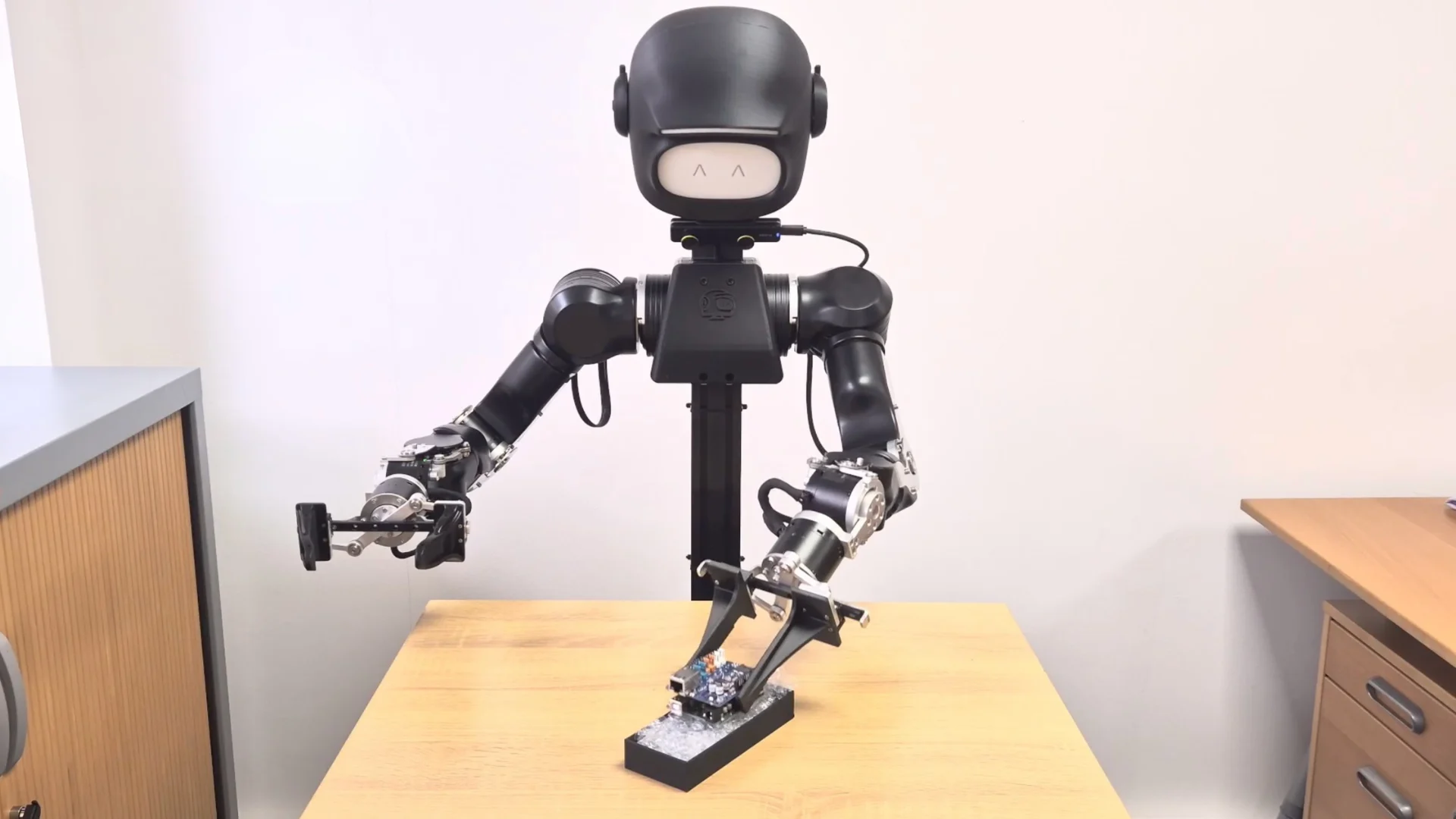
One of the hardest problems in commercial robotics deployment is making robots adaptable without incurring crippling engineering overhead. Traditional industrial integration requires days—or weeks—of hand-coded waypoints, environment-specific calibration, and iterative debugging for a single new manipulation task.
The Problem with the Old Way
The industry standard for deploying a new manipulation primitive—a contact-rich action like pick, place, insertion, or prep work—requires hours of custom engineering time.
Multiply that requirement across hundreds of high-mix industrial workflows and heterogeneous robot fleets, and the deployment economics collapse. Enterprise facilities cannot afford to halt production lines or hire specialized robotics engineers every time a SKU changes or a workstation is reconfigured.
How One-Shot Works
The One-Shot method combines visual human demonstration with Lili-O’s symbolic extraction pipeline. A human operator performs the workflow once in front of the robot.
The system captures the demonstration, extracts the critical contact geometry—where the end-effector makes and breaks contact, how force vectors are applied, and key spatial relationships—and compiles a bounded execution policy that generalizes across varied object poses without neural model retraining.
Three Stages of Compilation
- Demonstration: A single sub-60-second human run captured via multi-modal sensing.
- Extraction: The symbolic pipeline identifies contact geometry, approach trajectories, and physical constraints—eliminating hand-coded waypoints.
- Generalization: The resulting execution policy runs deterministically across spatial variations within the target workflow distribution.
Why Deterministic Generalization Matters
A skill that only works at the exact coordinates of the initial demonstration is useless on a real plant floor. Commercial environments demand that robots handle natural variations in object placement, orientation, and lighting without executing unpredictable "hallucinated" motions.
Lili-O’s One-Shot primitives encode physical contact geometry rather than rigid joint angles. Because execution logic is decoupled from low-level joint trajectories, a single demonstrated skill transfers seamlessly across multi-brand humanoid embodiments through our hardware abstraction layer.
We built One-Shot so enterprise operators can move from a single demonstration to bounded, deterministic execution—without weeks of integration.
What This Unlocks: Zero Marginal Engineering Cost
One-Shot is not a research curiosity—it is the operational foundation of day-one commercial deployment.
When a new workflow enters a facility, an operator demonstrates it once. Our deterministic engine extracts the primitives, compiles them into a bounded execution program, and begins SLA-backed operation within minutes—not weeks.
From there, Lili-O's symbolic execution engine takes over: chaining primitives into long-horizon tasks, executing bounded failure recovery, and maintaining operational uptime on a megabyte-scale edge CPU footprint. Fast, deterministic skill creation at the base level is what makes flexible physical AI commercially viable.